- DDE General scheme :
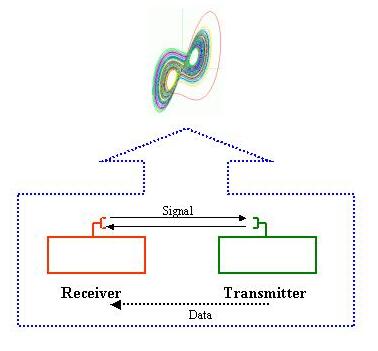
A nonlinear dynamic system which has an attractor is
split into two components: One component will be a receiver and the
other a transmitter. The transmitter and receiver are coupled through
a channel using bi-directional signal. The distributed dynamical system
which is comprised from the transmitter, receiver and the coupling bi-directional
signals possesses the same dynamics and converges to the same attractor
as the original dynamical system before the splitting took place.
- Message encoding :
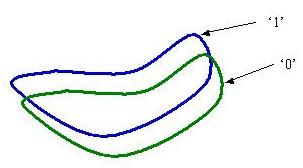
Data is transmitted by modulating the dynamics
of the transmitter. The dynamics (but not the state) of the transmitter
and the coupling bidirectional signals are assumed to be known to all and
serves as a public key. The dynamics and state of the receiver are the secret
key and assumed to be known only to the receiver.
- Message decoding :
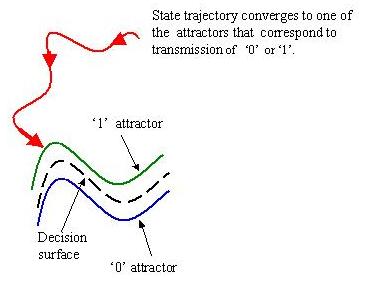
An authorized receiver who knows the whole dynamics
of the system can simulate the system off line, and find the position of
the attractors that correspond to the transmission of '0' and '1'.
Knowing the position of the attractors enable message decoding which is computationally
feasible.
- Security :
An unauthorized receiver who does not know the secret
key (the dynamics of the receiver) nor the state of the receiver does not
know the position of the attractors that correspond to the transmission
of '0' and '1', and is forced to use decoding methods that can be made
computationally unfeasible.
- Enhancement of security :
- Dynamics of receiver is altered before the beginning of transmission of each bit. This results in a change in the position of the attractors and makes reconstruction of attractors by an unauthorized receiver even less probable.
- The transmitter state is initiated with a random value at the beginning of each transmitted bit. Therefor the converging state trajectory will not remain constant during multiple transmission of the same bit.
- Trajectories that correspond to transmission of '0' and '1' are positioned
as close as possible. ( Analysis of security versus distance between attractors
can be found in paper.